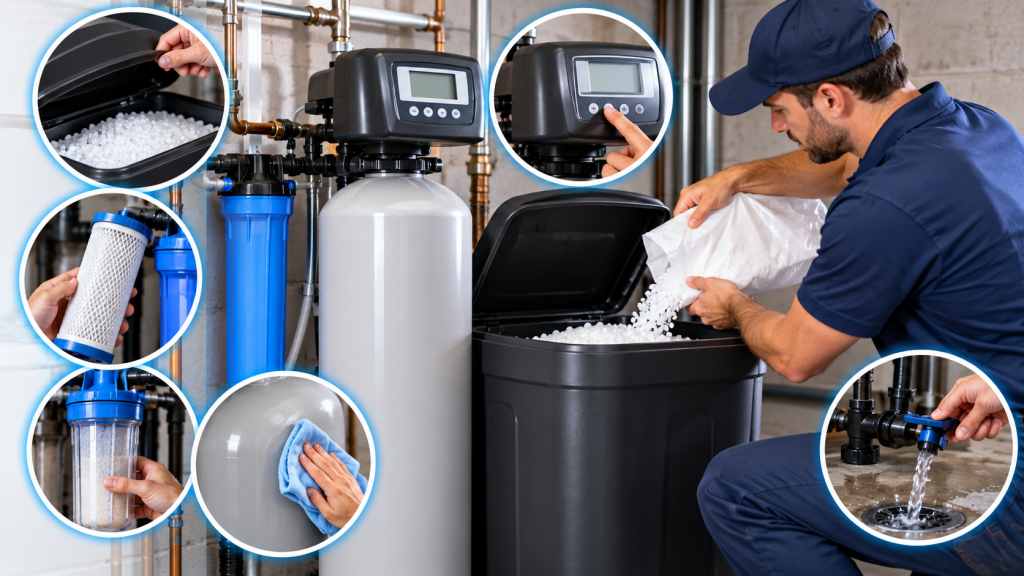
In Utah, where many homes deal with some of the hardest water in the country, your softener works hard every day. A little routine water softener maintenance keeps your system protecting your pipes, water heater, and fixtures for years, and it usually takes only a few minutes a month. Here is a practical checklist for homeowners anywhere along the Wasatch Front.
Why Water Softener Maintenance Matters in Utah
Many Wasatch Front homes see water well above 7 grains per gallon, and 10 to 20+ grains per gallon is common. Your softener does heavy lifting every day, and when it falls behind, minerals start building up again in your plumbing and appliances. Regular maintenance keeps water soft, avoids wasted salt, and catches small problems before they become costly repairs.
If you are not sure how hard your water is, a water test is the best place to start.
Your Water Softener Maintenance Checklist
Monthly (about five minutes)
- Check the salt level: Keep the brine tank at least one-quarter to one-half full, with salt a few inches above the water line. Running empty is one of the most common reasons hard water spots return.
- Look for salt bridges: A hard crust can form across the tank with an empty pocket underneath, so water cannot reach the salt. Press on it with a broom handle and carefully break up any hollow crust.
- Glance at the control valve: Confirm the display is on, the time is correct, and there are no error codes. After a power outage, a wrong clock can cause regeneration during peak water use.
Every Few Months and Once a Year
- Watch for salt mushing: Salt can recrystallize into sludge at the bottom of the tank and block the brine intake.
- Test your water: Hardness test strips on a kitchen faucet sample confirm the softener is working.
- Inspect connections: Check for drips around the bypass valve, inlet, outlet, and drain line, and make sure the bypass is in the “service” position.
- Clean the brine tank (yearly): Put the softener in bypass, scoop out old salt and sludge, rinse with water and mild soap, refill with fresh salt and a few gallons of water, then return to service.
- Review settings and resin (yearly): Match your hardness setting and regeneration schedule to current test results and household size. A softener resin cleaner can help if iron coats the resin beads.
Seasonal Tips and When to Call a Pro
- Winter: Protect softeners in garages or unheated spaces from freezing, which can crack valves and tanks.
- Summer: Irrigation usually does not need softened water, so keep sprinklers off the softener if your plumbing allows.
- Vacation homes: Mountain homes empty for weeks may need a check before heavy use resumes.
Call for service if you notice hard water spots despite full salt, a brine tank holding far more water than usual, salty water after regeneration, constant drain noise, resin beads in your faucets, or a 10 to 15+ year old system struggling to keep up.
Frequently Asked Questions
How often should I add salt to my water softener?
Most homes check salt monthly and add it as needed. Keeping the tank at least one-quarter full is a good habit.
Can I do water softener maintenance myself?
Yes. Checking salt, breaking bridges, cleaning the brine tank, and testing water are simple DIY tasks. Valve repairs and resin replacement are best left to a professional.
Need a Hand With Your Softener?
If your checklist turned up a problem, Expert Water Systems is here to help. With 24+ years in the industry and roughly 400 systems installed or serviced every year, we repair all kinds of softeners. If replacement makes more sense, we carry 20+ models at about half the price of the big national companies, and most installations are done in 1 day. Call (801) 836-4112 for free advice, or visit us at 1236 W 800 S, Lehi, UT 84043.