
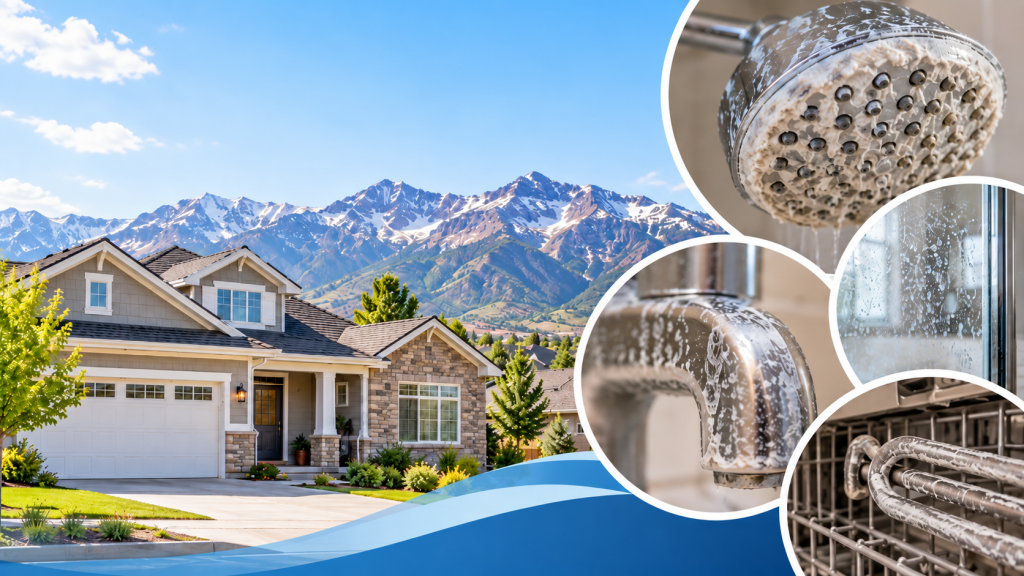
If you have scrubbed a chalky ring off your shower door in Lehi or noticed spots on “clean” dishes in West Jordan, you are not alone. Hard water in Utah is one of the most common complaints we hear along the Wasatch Front. Understanding where it comes from and what it does helps you decide how to handle it.
Water hardness is a measure of dissolved minerals, mainly calcium and magnesium, which rain and snowmelt pick up as they travel through soil and rock. Utah’s geology makes our water especially mineral-heavy:
The result is some of the hardest water in the United States. Many Wasatch Front homes see well above 7 grains per gallon (gpg), and 10 to 20+ gpg is common. As a guide (one gpg is about 17.1 mg/L), 7 to 10.5 gpg is hard and over 10.5 gpg is very hard. Levels vary between cities and neighborhoods.
Hard water is not considered a health risk, but when it is heated or evaporates, calcium and magnesium are left behind as scale.
The best way to know your hardness is a water test, which matters when choosing and sizing a system. Your city’s annual Consumer Confidence Report lists a system-wide range, but a test at your tap is more accurate. Homes on private wells, common in parts of Heber City and rural Utah County, should always test directly.
The right choice depends on your hardness, household size, budget, and goals.
Is hard water in Utah safe to drink?
Yes. Calcium and magnesium are not a health concern at typical levels. The main issues are scale, appliance wear, and effects on skin and hair.
Does hard water vary between Utah cities?
It can, depending on which sources your provider uses and how they blend them. A home test is the most reliable way to know.
Can I just clean the scale instead of treating the water?
Vinegar handles visible scale, but buildup inside pipes, water heaters, and appliances keeps growing. Treating water where it enters your home protects everything downstream.
At Expert Water Systems, we believe the best decisions come from good information. With 24+ years in the industry and roughly 400 systems installed or serviced each year, we explain your options in plain language, with no pressure. We carry 20+ softener models, our pricing is typically about half of the big national companies, and most installations are finished in one day.
Call Expert Water Systems at (801) 836-4112 or stop by our shop at 1236 W 800 S in Lehi. We serve Utah County, Salt Lake County, Davis County, Park City, Heber City, and beyond.