
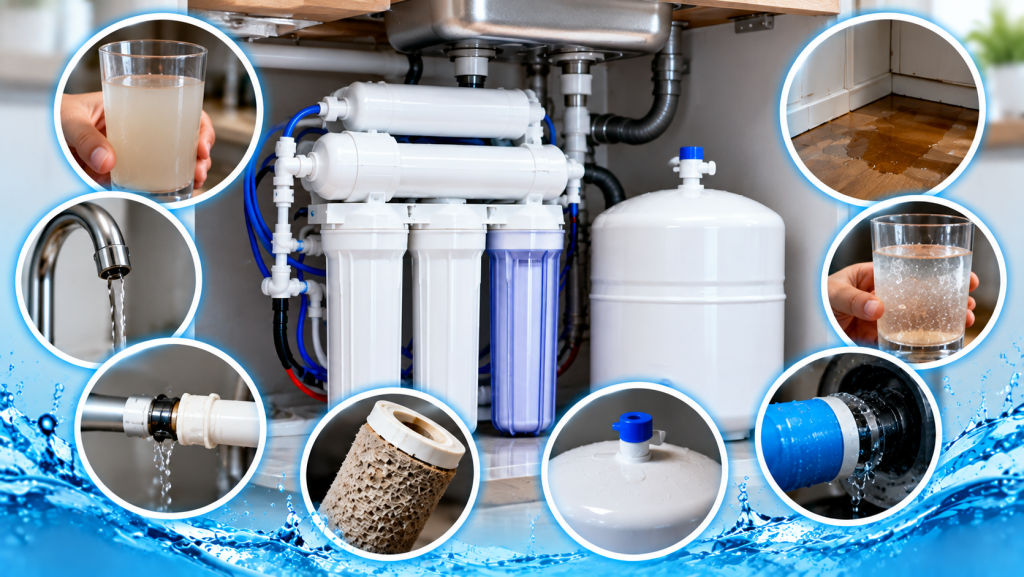
Like any equipment with filters, valves, and a membrane, a reverse osmosis system can wear out. Catching issues early can save you from leaks under the sink, wasted water, and drinking water that is not as clean as you think. Here are seven signs your system may need reverse osmosis repair, plus tips for Utah homeowners from Lehi to Magna.
Utah has some of the hardest water in the U.S., with many Wasatch Front homes well above 7 grains per gallon and 10 to 20+ common. Those minerals can foul a membrane and clog filters faster, especially without a softener, and sediment and chlorine add wear. Regular maintenance matters.
1. Flow has slowed to a trickle. Often caused by clogged pre-filters, a fouled membrane, low incoming pressure, or a tank that has lost its air charge.
2. Your water tastes or smells different. A metallic, bitter, musty, or chlorine taste can point to a spent post-filter, an old membrane, bacterial growth in an unsanitized tank or lines, or stale water after a long vacation.
3. The drain line runs constantly. Some drain flow while the tank fills is normal. Nonstop draining when the tank should be full can mean a faulty automatic shut-off valve, a bad check valve, or a tank problem.
4. Leaks or moisture under the sink. Cracked housings, worn O-rings, loose fittings, a failing faucet connection, or a damaged drain saddle can leak. Even a slow drip can damage cabinets and lead to mold. Turn off the RO supply valve and call for service if you cannot fix the source.
5. Strange noises. Some gurgling is normal. Constant gurgling often ties to drain line issues, hissing or spitting at the faucet can mean air in the lines or a tank problem, and clicking or humming may mean a booster pump is running too much.
6. Cloudy or milky water. Cloudiness right after a filter change is usually trapped air. If it persists, the membrane, filters, or fittings may be the cause.
7. High TDS readings. An inexpensive TDS meter compares total dissolved solids in tap and RO water. A working system shows a large drop. If RO readings climb toward tap levels, the membrane may be worn or a seal may be letting untreated water bypass it.
Not every problem means a new system. Many issues are fixed with new filters or a membrane, replacement O-rings and fittings, recharging or replacing the tank, or repairing the shut-off valve or faucet. Replacement may make sense if the system is very old, parts are hard to find, housings are cracked, or repair costs approach the price of a new unit.
To prevent repairs, change filters on schedule, sanitize during filter changes, check under the sink every few weeks, and consider a softener for very hard water.
Can I repair my reverse osmosis system myself?
Filter changes are manageable. Valve, tank, connection, or membrane problems are often easier and safer to leave to a professional.
How do I know if my RO membrane is bad?
Slow flow that does not improve with new filters, a taste change, and rising TDS readings are common signs. A technician can confirm.
Is it safe to keep using my RO water if something seems wrong?
If the water tastes, smells, or looks unusual, stop drinking it until the system is checked.
Expert Water Systems can help you decide whether a simple fix or a replacement makes the most sense. We have more than 24 years in water treatment and install or service about 400 systems each year throughout Utah. Our pricing is typically about half what the big national companies charge, and most new installations are finished in one day.
Call (801) 836-4112 for free advice or to schedule reverse osmosis repair, or visit us at 1236 W 800 S in Lehi. We serve Utah County, Salt Lake County, Davis County, West Jordan, South Jordan, Herriman, Vineyard, Park City, Heber City, and nearby communities.