
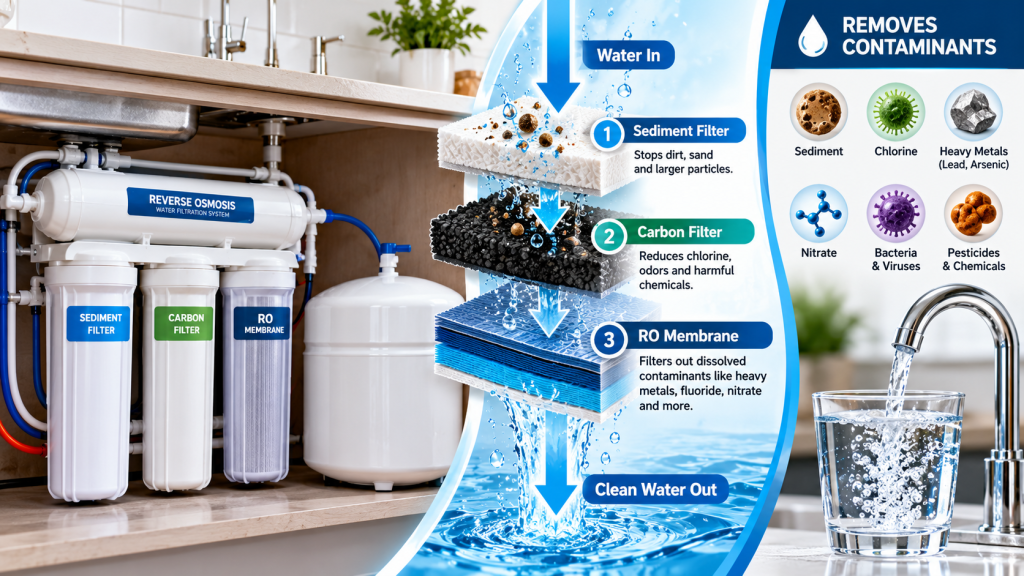
You have probably seen a small extra faucet beside a kitchen sink and heard someone say, “That’s our RO water.” RO is one of the most popular ways Utah families improve their drinking water. This guide explains how reverse osmosis works so you can decide whether an RO system makes sense for your home in Lehi, South Jordan, or Vineyard.
In regular osmosis, when two solutions are separated by a semi-permeable membrane, water moves from the less concentrated side toward the more concentrated side.
Reverse osmosis flips that process. Water pressure pushes water through a very fine membrane from the more concentrated side to the cleaner side. Water molecules pass through, while many dissolved solids, minerals, and other contaminants are held back and rinsed down the drain.
A typical under-sink system has five stages:
Depending on the system and water, the membrane can reduce hardness minerals, salts and total dissolved solids (TDS), many metals such as lead and arsenic, nitrates, and fluoride. The rejected water, called brine, carries them to the drain. Some systems add a remineralization filter that returns a little calcium and magnesium for taste, or a UV light for extra protection against microorganisms.
Utah has some of the hardest water in the U.S., with many Wasatch Front homes well above 7 grains per gallon and 10 to 20+ common. Hardness is not a health threat, but minerals and dissolved solids affect taste, spot glassware, and scale coffee makers and kettles. Families choose RO for better-tasting water and coffee, clearer ice, less bottled water, and more confidence in what their kids drink. Your provider’s annual Consumer Confidence Report and a home test show what is in your water.
A softener treats all the water in your home to protect pipes and appliances, while RO treats water at one tap for drinking and cooking. Many Utah homeowners use both. Softened water can help an RO membrane last longer, and RO reduces much of the sodium softened water contains.
Before installing, consider:
Does reverse osmosis remove everything from water?
No method removes 100 percent of everything, but RO reduces a wide range of dissolved solids and many contaminants. Results depend on your water, the system, and maintenance.
Is reverse osmosis water safe to drink?
Yes, RO water is widely used for drinking and cooking. For more, see our article “Is Reverse Osmosis Drinking Water Really Safe?”
How long does it take to fill an RO storage tank?
It depends on the system, pressure, and temperature. Tank systems refill over a period of hours, while tankless systems filter on demand.
Expert Water Systems has spent more than 24 years in water treatment and installs or services about 400 systems a year across Utah. Most RO installations are done in a single day, typically at about half of what the big national companies charge.
Call (801) 836-4112 for free, no-pressure advice, or visit us at 1236 W 800 S in Lehi. We serve Utah County, Salt Lake County, Davis County, Eagle Mountain, Saratoga Springs, Spanish Fork, Santaquin, Park City, Heber City, and more.