
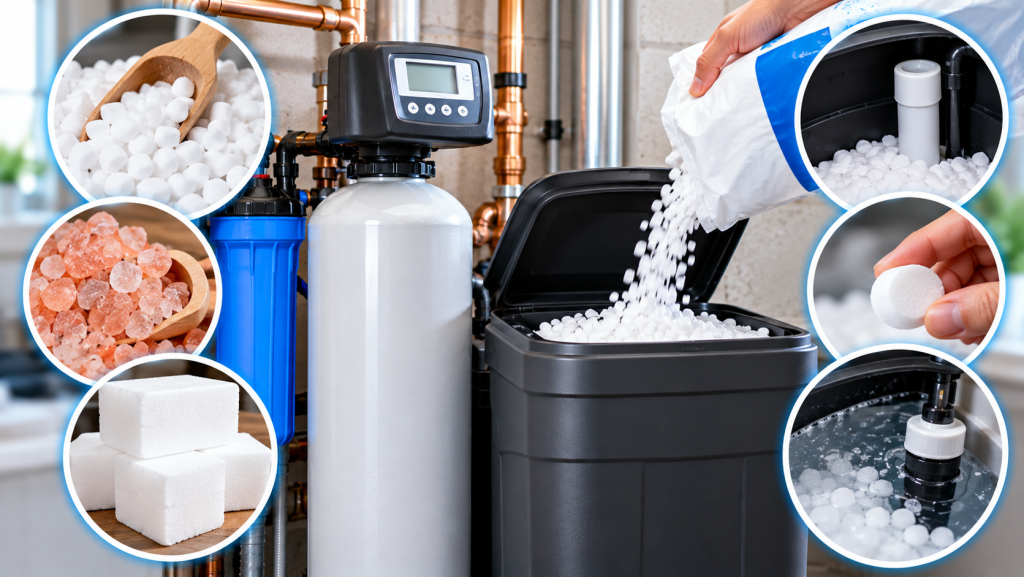
Walk down the water softener aisle at any Utah home improvement store and you will find a surprising number of choices. Pellets, crystals, solar salt, rock salt, potassium chloride, and “rust-fighting” blends all promise to keep your system running well. So which is the best water softener salt for your home? The answer depends on your softener, your water, and your priorities.
Your softener uses salt to create brine, which recharges the resin beads that remove hardness minerals. The salt does not soften the water directly, but it keeps the system working.
Many Wasatch Front homes see water well above 7 grains per gallon, and 10 to 20+ grains per gallon in many areas, so softeners regenerate frequently. Your salt type can affect how clean your brine tank stays, whether you get salt bridges or mushing, how often you refill, and long-term performance.
Pellets are evaporated salt compressed into uniform shapes and one of the most popular choices. Their high purity means less residue, they dissolve evenly, and they are less likely to cause mushing than many other types. They cost a bit more than rock or solar salt. For most homeowners in Lehi, Saratoga Springs, and similar communities, pellets are a reliable, low-maintenance choice.
Crystals, often sold as solar salt, are made by evaporating seawater or brine with sunlight. They are generally high purity, often a good value, and work well in many two-tank systems. Their irregular shapes can be more prone to bridging in some brine tanks, and some manufacturers recommend pellets for specific models, so check your owner’s manual.
Mined rock salt is usually the cheapest and easy to find, but it contains more insoluble impurities, leaves more sediment, and requires more frequent tank cleaning.
This sodium-free alternative adds potassium instead of sodium to softened water, making it a common choice for people watching sodium intake. It is usually significantly more expensive, less efficient, and not every system can use it without setting changes. Another option is to keep regular salt in your softener and add a reverse osmosis system at the kitchen sink for drinking and cooking water.
Salt with iron or rust additives can help if your water contains iron, but not every home needs it. A water test is the best way to find out.
Whatever you choose, avoid mixing salt types in the same brine tank, since it can increase bridging and mushing.
Is it okay to switch salt types?
Yes. Let the current salt run low before switching rather than layering types together. If you switch to potassium chloride, your settings may need adjusting.
How much salt does a water softener use?
It depends on water hardness, household size, and system efficiency. A high-efficiency softener that regenerates based on actual water use can reduce salt consumption.
Not sure which salt your system needs, or wondering if your softener uses more salt than it should? Expert Water Systems is happy to help. We have 24+ years in water treatment and install or service roughly 400 systems a year across Utah County, Salt Lake County, and beyond. If an upgrade makes sense, our high-efficiency models can help cut salt use, typically at about half the price of the big national companies, with most installations completed in 1 day. Call (801) 836-4112 for free advice.