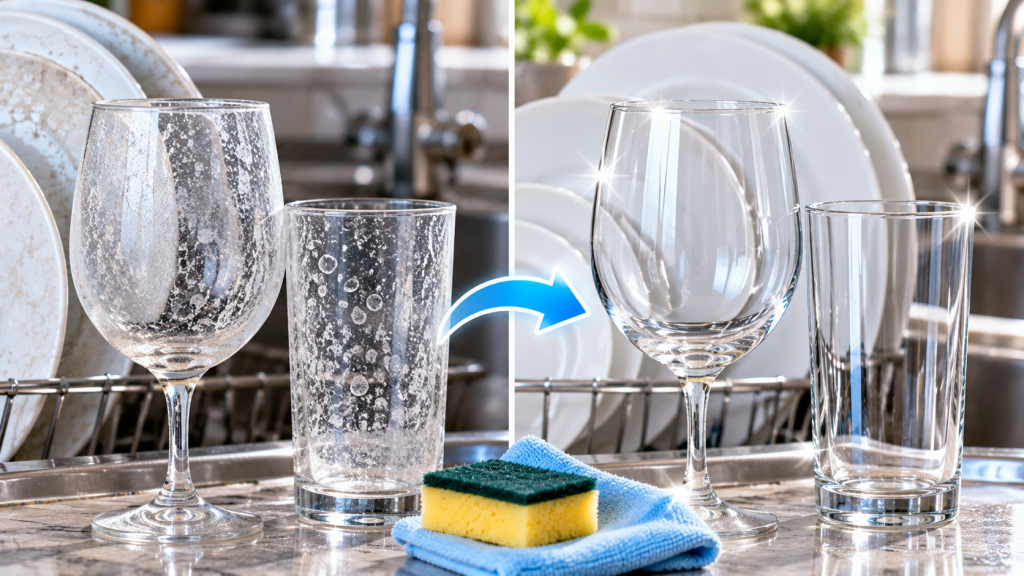
You run the dishwasher, open the door, and find cloudy glasses covered in white film. Hard water spots are one of the most common complaints we hear from homeowners across Utah County, Salt Lake County, and Davis County. The good news is that they can be removed with simple household products, and the right water treatment keeps them from coming back.
What Causes Hard Water Spots?
Hard water carries dissolved minerals, mainly calcium and magnesium. When a drop of water dries on a surface, the water evaporates but the minerals stay behind as white, chalky spots.
Utah has some of the hardest water in the U.S. Many Wasatch Front homes see water well above 7 grains per gallon, and 10 to 20+ grains per gallon is common. The harder your water, the faster spots and film build up.
How to Remove Hard Water Spots
Dishes and glassware
- Soak in white vinegar: Vinegar is mildly acidic and helps dissolve mineral deposits. Soak glasses and dishes in equal parts warm water and white vinegar for 15 to 30 minutes, scrub gently, rinse, and dry right away with a microfiber towel.
- Clean the dishwasher: Run an empty hot cycle with a dishwasher-safe cup of white vinegar on the top rack, and check the spray arms for scale clogs.
- Use a rinse aid: It helps water sheet off dishes instead of forming droplets, and fewer droplets means fewer spots.
- Know when it is etching: If cloudiness does not come off with vinegar, your glassware may be etched. Etching is permanent surface damage. Spots can be removed; etching cannot.
Shower doors
- Vinegar spray: Warm white vinegar slightly, spray the glass generously, let it sit 10 to 15 minutes, then wipe with a non-scratch sponge, rinse, and dry.
- Baking soda paste: For heavier deposits, apply a paste of baking soda and a little vinegar or water, let it sit a few minutes, scrub gently, and rinse well.
- Squeegee after every shower: Removing water before it dries can cut down on spots significantly.
Faucets, showerheads, and tile
- Faucets: Wrap a vinegar-soaked cloth around the fixture for 30 minutes, then wipe clean.
- Showerheads: Tie a vinegar-filled plastic bag around the head and soak for an hour or more.
- Tile and grout: Use a vinegar spray and a soft brush, but avoid vinegar on natural stone like marble or granite.
Always test any cleaner on a small hidden area first.
How to Stop Hard Water Spots for Good
Cleaning removes spots, but it does not solve the source. Whether you live in Lehi, Eagle Mountain, or Magna, the spots will keep coming back as long as the minerals are in your water.
- Test your water. A test tells you how hard your water is and what treatment makes sense.
- Consider a water softener. It removes calcium and magnesium before water reaches your fixtures, meaning fewer spots, less scrubbing, and less scale in your water heater and pipes.
- Add reverse osmosis for drinking water. An RO system at the kitchen sink reduces many dissolved solids and pairs well with a softener.
Frequently Asked Questions
Are hard water spots harmful?
They are not a health concern, but they signal mineral content that can cause scale buildup in water heaters, pipes, and appliances over time.
Will a water softener remove existing hard water spots?
No. It prevents new spots, so clean surfaces once with vinegar and soft water helps keep them clean.
Say Goodbye to Spots With Expert Water Systems
Tired of scrubbing? Expert Water Systems helps homeowners across the Wasatch Front, from Spanish Fork to Herriman, choose the right water softener or conditioner. Our systems typically cost about half the price of the big national companies, and most installations are finished in 1 day. Call (801) 836-4112 today for free advice from a team with 24+ years in water treatment.