
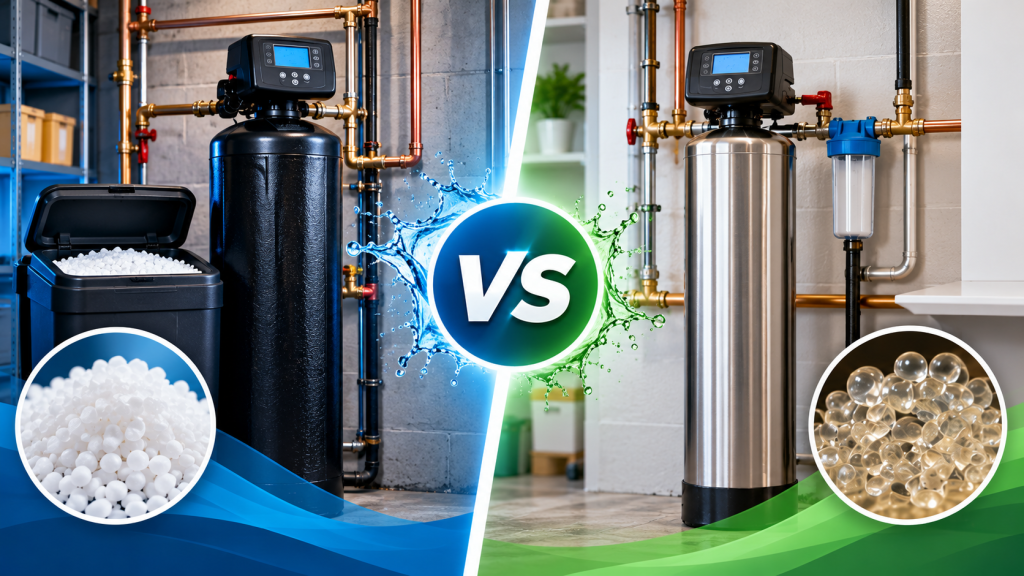
Few home upgrades spark as much debate as salt. Some Utah homeowners would never give up the silky feel of softened water, while others love never hauling another bag of salt. If you have been researching a salt-free water softener for your home in Lehi, Mapleton, or Park City, here is a balanced look at the pros and cons of each.
Utah water is often well above 7 grains per gallon, with 10 to 20+ gpg common. Its calcium and magnesium leave scale on faucets, shower doors, water heaters, and appliances. Both system types reduce that scale by very different paths.
A salt-based softener uses ion exchange. Resin beads trap calcium and magnesium and release sodium. When the resin is full, the system regenerates with brine from a second tank, sending the minerals down the drain.
Pros:
Cons:
The term salt-free water softener is a bit of a misnomer; these systems are conditioners. Instead of removing minerals, they change them so they are less likely to stick. The most common method, template assisted crystallization (TAC), converts minerals into microscopic crystals that stay suspended and flow through.
Pros:
Cons:
Salt-based systems carry ongoing salt costs, some water and electricity use, and occasional service, though resin can last many years. Salt-free systems need no salt and typically no power, with media replacement every few years and occasional prefilter changes. Both can be good long-term investments.
Choose salt-based if your water is very hard, you want spot-free dishes and a soft feel, protecting your water heater and appliances is a top priority, and you do not mind adding salt.
Choose salt-free if you want no salt and low maintenance, your HOA limits softener discharge, you mainly want to reduce scale, you prefer to keep minerals, or space, drain, or power access is limited.
Homeowners in Davis County, Heber City, and West Jordan often land on different answers, so start with a water test and your provider’s Consumer Confidence Report.
Does a salt-free water softener really soften water?
Not technically. It conditions water so minerals are less likely to form scale, but they remain. Only ion exchange removes hardness.
Is softened water safe to drink?
For most people, yes. If you are watching sodium, use potassium instead of salt or add reverse osmosis for drinking water.
Will a salt-free system protect my water heater?
It is designed to reduce scale there, though results vary. For very hard water, a salt-based softener typically offers the most complete protection.
At Expert Water Systems, we install both salt-based softeners and salt-free conditioners, with 20+ softener models from budget-friendly to premium high-efficiency. Our pricing is typically about half of the big national companies, and most installations are completed in one day.
Reach out at (801) 836-4112 for free advice from a team with 24+ years in water treatment, whether you live in Lehi, Santaquin, South Jordan, or anywhere across our service area.