
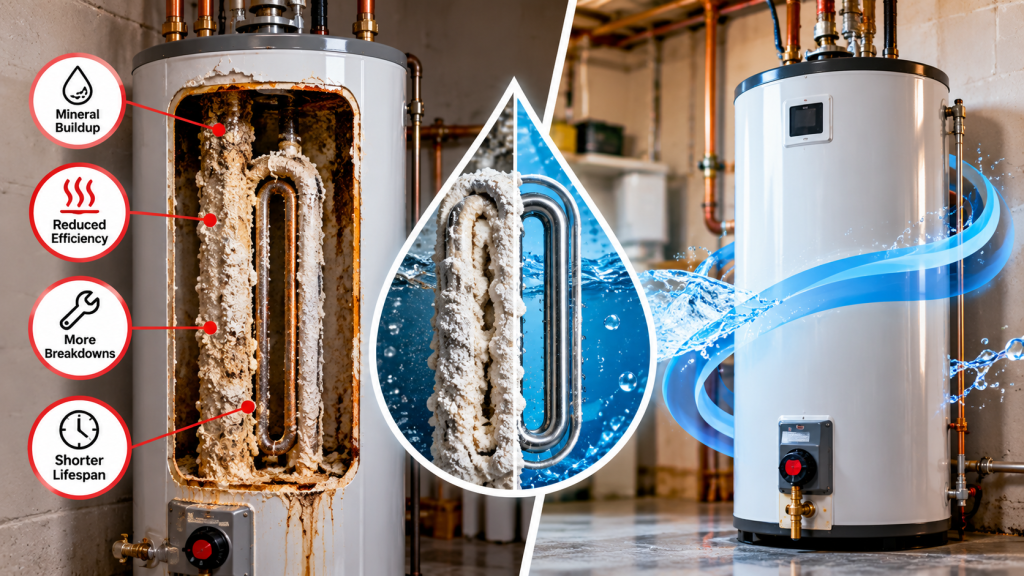
Your water heater is easy to forget until the morning the shower runs cold. For many Utah homeowners, that day comes early because of mineral scale left by hard water. If you live anywhere along the Wasatch Front, from Lehi to West Jordan to Spanish Fork, understanding how a hard water water heater ages can save you money, energy, and a surprise replacement bill.
Utah has some of the hardest water in the United States. Many homes in Utah County, Salt Lake County, and Davis County see water well above 7 grains per gallon, and 10 to 20+ grains per gallon is common. That hardness comes from dissolved calcium and magnesium.
Heat pulls calcium carbonate out of solution as a hard, chalky solid, so a water heater becomes a collection point for these minerals. Check your provider’s annual Consumer Confidence Report, or better yet, test at the tap.
In a tank-style heater, scale settles on the tank bottom, coats electric elements, and narrows pipes and valves. Tankless heat exchangers can clog, reducing flow and triggering error codes.
Scale acts like a blanket between the heat source and the water, so the burner or element runs longer and hotter. That stress wears parts out early.
Hard water damage builds slowly. Watch and listen for:
If you hear rumbling or notice leaking, have a qualified plumber check the unit. Scale costs you in energy, maintenance, and lifespan.
Flush the tank. Draining sediment from the bottom of the tank removes it before it hardens. Many homeowners aim for once a year. Call a professional if you are not comfortable with gas or electrical equipment.
Check the anode rod. This sacrificial rod attracts corrosion so your tank does not, and hard water can wear it down faster. Inspect it every few years and replace it when it is mostly gone.
Descale tankless units. These need periodic descaling with a flushing kit.
Treat the water first. Flushing manages symptoms; treatment addresses the cause. A water softener removes calcium and magnesium through ion exchange, so far less scale forms, protecting the water heater and every fixture downstream. A water conditioner is another option for some homes. Expert Water Systems offers more than 20 softener models, from budget-friendly to premium high-efficiency.
Can hard water really shorten the life of a water heater?
Yes. Scale makes the burner or elements run longer and hotter, and that stress, along with sediment and corrosion, can lead to earlier failures.
Will a water softener remove scale already in my water heater?
Softened water slows new buildup and may loosen some deposits over time, but it does not replace flushing. Heavy sediment calls for a thorough flush or professional service first.
How do I know how hard my water is?
Start with your provider’s Consumer Confidence Report, then confirm with a water test at your home.
If your water heater is rumbling or running out of hot water early, Expert Water Systems can help. With more than 24 years in water treatment and roughly 400 systems installed or serviced each year, our team knows Utah water. Most installations are finished in one day, typically at about half the price of the big national companies.
Call (801) 836-4112 for free advice, or stop by our shop at 1236 W 800 S in Lehi. We serve Lehi, Eagle Mountain, Saratoga Springs, Vineyard, Herriman, South Jordan, Heber City, and communities throughout Utah, Salt Lake, and Davis counties.