
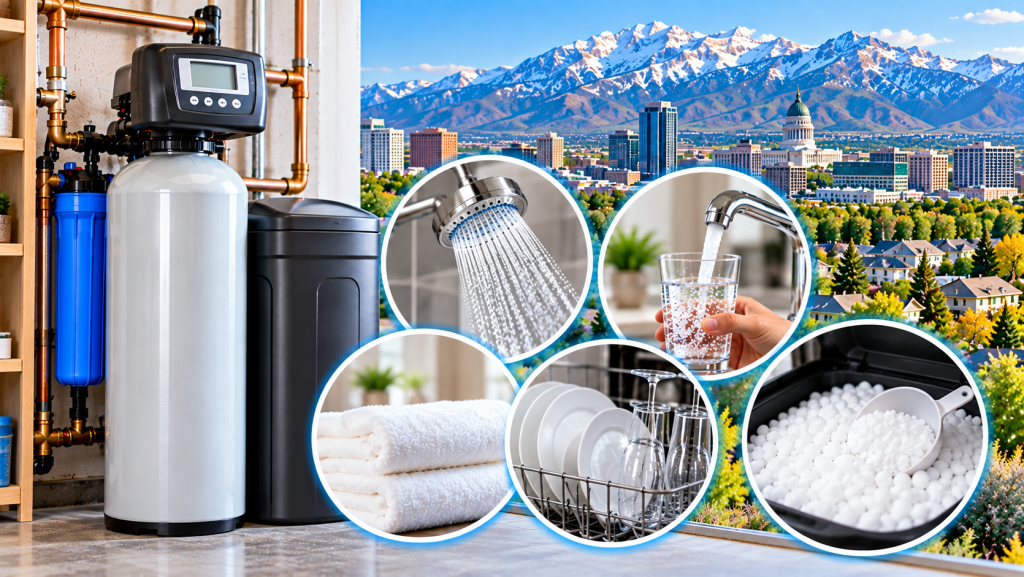
If you live on the west side of the valley, you have probably seen the signs of hard water: white crust around the faucet, cloudy spots on the dishes, and a shower door that never stays clean. Homeowners in West Jordan, South Jordan, Herriman, and Magna deal with this every day. This guide explains what a water softener in Salt Lake County can do for your home and how to pick a system that fits your household and budget.
Utah has some of the hardest water in the United States. As water moves through the rock and soil around the Wasatch Front, it picks up calcium and magnesium and carries them into your pipes, fixtures, and appliances.
Hardness is measured in grains per gallon (gpg). Water above about 7 gpg is considered hard, and readings of 10 to 20 gpg or more are common in many areas. Your provider’s annual Consumer Confidence Report offers general results, but a water test at your home gives the most accurate picture.
Hard water is not usually a health concern, but it is tough on a house:
Treating the water at the source costs far less than replacing a water heater early.
A water softener removes hardness minerals before water reaches the rest of your home. Most systems use two tanks:
Modern high-efficiency softeners regenerate only when needed, saving salt and water compared to older timer-based units. Water conditioners reduce the effects of scale but do not remove hardness minerals the way a softener does.
The right system depends on your water hardness, household size, plumbing layout, budget, and space. A family of six in Herriman uses much more water than a couple in a Magna starter home. Many newer homes in South Jordan and Herriman have a softener loop, which makes installation quicker, while older homes in West Jordan and Magna may need extra plumbing work.
A system that is too small will regenerate constantly and wear out faster; one that is too large costs more than you need to spend. Before you buy, ask how your hardness was measured, why a given size fits your household, and whether the installer can service the system later.
Do I need a water softener if I live in Salt Lake County?
Most Wasatch Front homes have hard water, often well above 7 grains per gallon. If you notice scale or spotty dishes, a softener is worth considering.
How long does it take to install a water softener?
Most installations are completed in one day. Homes with an existing softener loop are usually the quickest.
Will a water softener make my water salty?
Softened water contains a small amount of sodium, but most people do not taste it. You can also add a reverse osmosis system at the kitchen sink for drinking water.
Expert Water Systems has spent more than 24 years helping Utah homeowners make informed decisions about their water. We install and service roughly 400 systems a year and carry over 20 softener models, from budget-friendly options to premium high-efficiency units. Our prices typically run about half of what the big national companies charge, and most installs are done in one day.
If you live in West Jordan, South Jordan, Herriman, Magna, or anywhere in Salt Lake County, call us at (801) 836-4112. We will help you find the right system, with no pressure.