
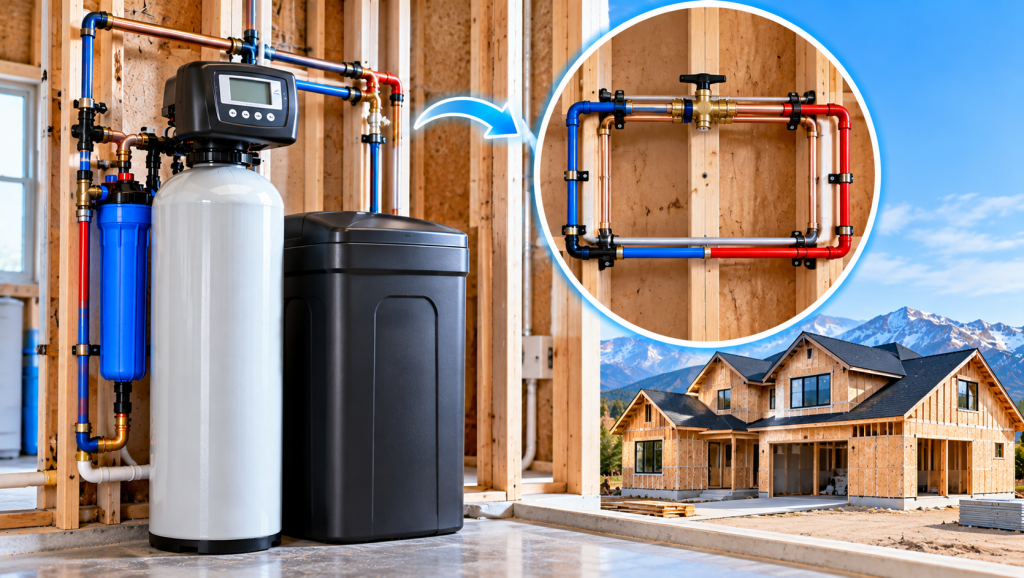
Building a new home means a hundred decisions before move-in day, from floor plans to paint colors. One small item that is easy to overlook is the water softener loop. If you are building in Lehi, Saratoga Springs, or Eagle Mountain, this simple plumbing feature can save you time, money, and frustration. Here is what a water softener loop in new construction is, why it matters in Utah County, and what to ask your builder before the walls go up.
A softener loop routes your home’s main water line to a convenient spot, usually the garage, basement, or a utility room, and then back into the house. It typically includes:
Indoor fixtures receive softened water, while outdoor spigots and sprinkler lines are usually left on hard water. There is no reason to soften water for your lawn.
Utah has some of the hardest water in the country, with readings of 10 to 20 gpg or more common in many areas. A new home’s water heater, dishwasher, faucets, and shower valves start building scale from day one, so installing a softener early protects that investment. A home water test gives the most accurate hardness reading for sizing a system.
Adding a loop during construction is simple because the walls are open and the plumber is already running lines. Adding one later can mean cutting into finished drywall, running new pipe, adding an unplanned drain and outlet, and patching and painting afterward. That costs more time and money, and the softener may end up in a less than ideal spot.
Even if you are not ready to buy a softener on move-in day, a loop lets you add one any time.
Before your plumbing rough-in, ask:
If your builder offers a softener in the package, compare it with an independent local installer, since builder-supplied systems are not always sized for your household or water hardness. Many new homeowners also add a reverse osmosis system under the kitchen sink for drinking water.
Can I add a water softener loop after my home is built?
Yes, but it usually requires more plumbing work and sometimes drywall repair. If your home is still being built, now is the best time to request one.
Where should the softener loop be located?
The garage is most common in Utah County, though basements and utility rooms also work. It needs room for two tanks, a drain, an outlet, and freeze protection.
How long does it take to install a softener on an existing loop?
Most installs are completed in one day, and many take just a few hours.
Expert Water Systems is based in Lehi and has helped Utah homeowners with water treatment for more than 24 years. We install and service roughly 400 systems each year and carry over 20 softener models to fit every budget. Our pricing is typically about half of what the big national companies charge, and most installations are finished in a single day.
Building in Lehi, Saratoga Springs, Eagle Mountain, or elsewhere in Utah County? Call us at (801) 836-4112 and we will help you choose a system that fits your home and budget.