
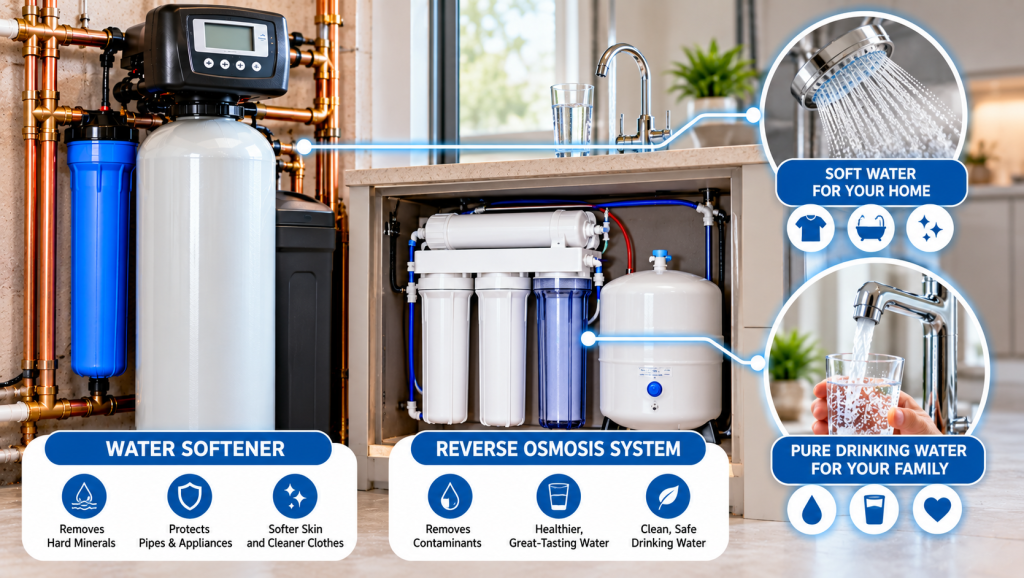
When Utah homeowners start looking into water treatment, they often ask: should I get a softener or a reverse osmosis system? For many homes, the answer is both. A water softener and reverse osmosis system each solve a different problem, and together they cover almost everything most households want from their water.
Think of your home’s water in two categories. Water you use covers showers, laundry, dishes, toilets, and appliances. This is most of your water, and hardness minerals in it cause scale, spots, and wear. Water you drink covers glasses of water, coffee, ice, and cooking. It is a small portion of your use, but it is the part you taste every day. A softener handles the first category; reverse osmosis handles the second.
Utah has some of the hardest water in the country, with 10 to 20 gpg or more common in many areas. A softener is usually installed where the main line enters the home, so it treats the whole house. Resin beads in the mineral tank capture calcium and magnesium and exchange them for sodium or potassium, and a brine tank holds salt that cleans the resin during regeneration. The results include less scale, fewer spots on dishes, better lather, and longer appliance life. A softener targets hardness, though, and is not a full drinking water filter.
A reverse osmosis system is typically installed under the kitchen sink with its own faucet. Water passes through a sediment prefilter, a carbon prefilter for chlorine, taste, and odor, the RO membrane that separates many dissolved solids, a storage tank, and a carbon post-filter for a final polish. The result is clean, crisp water for drinking and cooking,.
The two systems help each other:
The combo tends to be a great fit if you notice scale and spotty dishes, buy bottled water or use pitcher filters, dislike the taste of your tap water, or want to protect new appliances. If budget is a concern, you do not have to install both at once. Many homeowners start with a softener, then add RO later. A home water test is the best way to understand what is in your water, and your provider’s Consumer Confidence Report offers helpful background.
Can I install a reverse osmosis system without a water softener?
Yes. RO works on its own, but in very hard water areas like much of Utah, a softener helps protect the membrane and can extend its life.
Where is the reverse osmosis system installed?
Most are installed under the kitchen sink with a dedicated faucet. Some homeowners also run a line to the refrigerator for filtered ice and water.
How long does it take to install both systems?
In many homes, both can be installed in a single day, especially with an existing softener loop.
Expert Water Systems has more than 24 years of experience installing and servicing water softeners, water conditioners, and reverse osmosis systems throughout Utah. We handle roughly 400 systems a year, from Lehi and Utah County to Salt Lake County, Davis County, Park City, and Heber City. With over 20 softener models, we can match a system to your home and budget, often at about half the price of the big national companies, and most installs wrap up in one day.
Curious whether a softener and RO combo makes sense for you? Call (801) 836-4112 and we will explain your options in plain terms.