
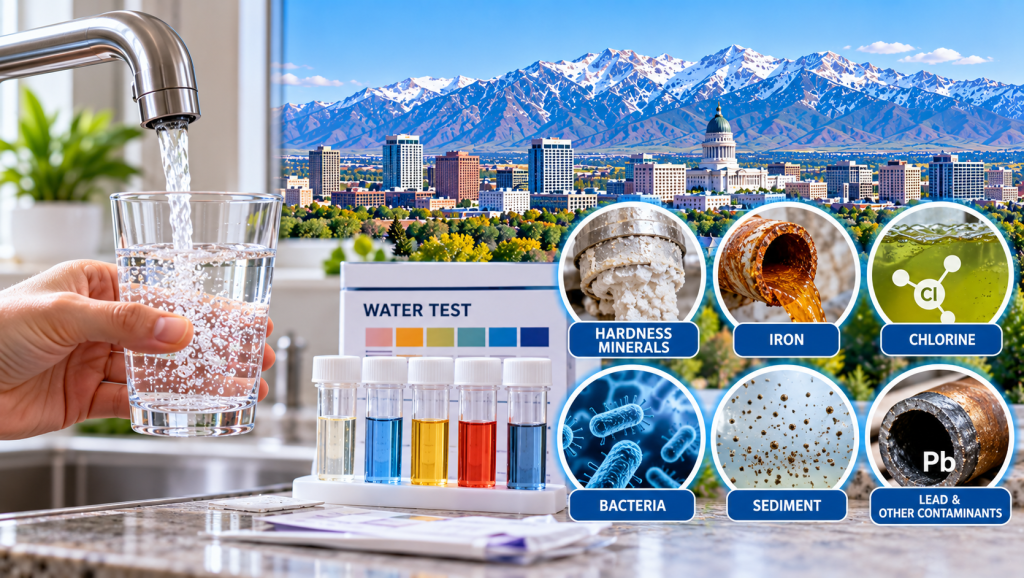
You turn on the tap dozens of times a day, but how much do you know about what is in that water? For many Utah families, the first clue is white scale on the faucet or a funny taste in a glass of water. Water testing in Utah is the simplest way to replace guesswork with real information. This guide explains what is commonly found in Utah tap water, how to test it, and what to do with the results.
Public water systems in Utah are regulated and tested, but that testing happens at the treatment plant and across the system, not at your kitchen sink. Your water can be affected by the age and material of your plumbing, where your home sits in the distribution system, blending from different sources, existing treatment equipment, and private wells, which public testing does not cover.
Common things Utah homeowners want to know about include:
Every public water provider must publish an annual Consumer Confidence Report, or water quality report, usually on your city or water district’s website. Look for your water source, detected contaminants and their levels, any violations or notices from the past year, and hardness information if included. The report reflects the system as a whole, so a home test is the next step.
Testing options range from simple to detailed:
For accurate results, test from a faucet that has not been through a softener or filter, run the tap briefly first, follow the instructions carefully, and test again after installing a system.
For high hardness, a water softener removes calcium and magnesium throughout the house, and a water conditioner is another option for managing scale. For high TDS or taste concerns, a reverse osmosis system under the kitchen sink provides clean drinking water. Many Utah homes benefit from both. Your results also help size a softener correctly so it works efficiently and lasts longer.
How often should I test my water in Utah?
Test when you move into a new home, before buying treatment equipment, and periodically afterward. Private well owners should test more regularly.
Is Utah tap water safe to drink?
Public systems are regulated, and your Consumer Confidence Report shows how your water measures up. Many people still choose RO for better taste and peace of mind.
Can a home test tell me what size softener I need?
Yes. Your hardness reading, combined with household size and water use, is the key to sizing a softener.
At Expert Water Systems, we believe the best water treatment decision is an informed one. With more than 24 years in the industry and roughly 400 systems installed and serviced each year, we help homeowners across Lehi, Utah County, Salt Lake County, Davis County, Park City, and Heber City understand their water before recommending anything. We offer more than 20 softener models plus reverse osmosis, typically at about half the price of the big national companies, and most installs are done in one day.
Want to know what is in your tap water? Call (801) 836-4112, and we will help you understand your results with no pressure.