
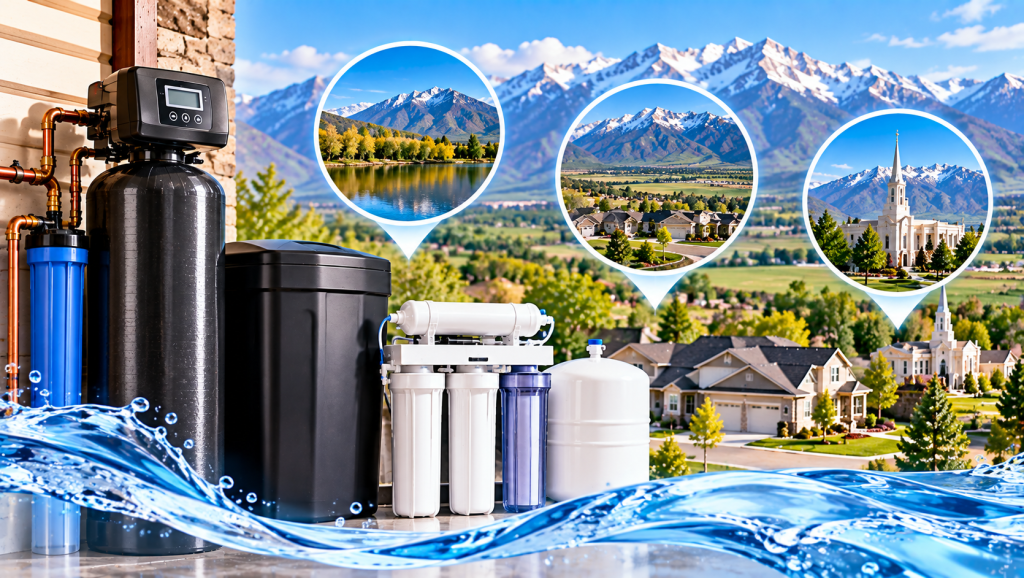
South Utah County has a lot going for it: mountain views, room to breathe, and growing neighborhoods. Whether you live in Spanish Fork, a newer Mapleton subdivision, or near the Santaquin foothills, most local households share one thing: hard water. If you are considering a water softener in Spanish Fork or a nearby community, this guide covers your water, your treatment options, and how to pick a system that fits your home and budget.
Utah has some of the hardest water in the United States. Water traveling through the mountains and valleys picks up calcium and magnesium, and readings of 10 to 20 or more grains per gallon are common along the Wasatch Front.
Hardness varies by source and even by street. Spanish Fork, Mapleton, and Santaquin each have their own municipal systems, and some rural properties rely on private wells. Each city publishes an annual Consumer Confidence Report, but an in-home water test gives the most accurate picture.
Common signs include white crust on faucets, spots on dishes and shower doors, dry skin and dull hair, stiff laundry, poor soap lather, and scale in the water heater.
A softener uses ion exchange, trading hardness minerals for sodium or potassium, so water is easier on plumbing, appliances, skin, and laundry.
Sizing matters. Start with how hard your water is and how much your household uses. A family of six in a larger Mapleton home needs something different than a couple in a Santaquin rambler. An undersized softener regenerates constantly and may let hard water through, and a poorly matched one can waste salt and water.
Efficiency options. Demand-initiated softeners regenerate only when needed, often saving salt and water. Budget-friendly models can also be a great fit when sized correctly.
Water conditioners. Some homeowners prefer a conditioner instead of, or alongside, a softener. Conditioners help reduce scale but work differently than a salt-based softener, so talk through the pros and cons first.
A softener is not designed to filter drinking water, so many families add an under-sink reverse osmosis (RO) system for drinking, cooking, coffee, and ice. RO pushes water through a fine membrane that reduces many dissolved solids, and the softener protects that membrane from scale. See our earlier article, “Is Reverse Osmosis Drinking Water Really Safe?”
Installation is simple: a water test and consultation, a review of budget-friendly and premium options, installation, usually completed in one day, including plumbing, drain setup, and programming, and a walkthrough on salt and maintenance. We also repair softeners and RO systems that are not performing well.
Do you serve homes outside Spanish Fork city limits?
Yes. We serve Mapleton, Santaquin, all of Utah County, Salt Lake County, Davis County, Park City, Heber City, and more.
Is well water treated differently?
Well water can differ from city water and is not covered by a Consumer Confidence Report, so testing is especially important and helps us recommend the right equipment.
How long does a water softener last?
With proper sizing, regular salt, and occasional maintenance, a quality softener can serve a home for many years, and our repair services can help extend its life.
Expert Water Systems has more than 24 years of experience and installs or services roughly 400 systems a year. We offer more than 20 softener models, water conditioners, and RO systems, at prices typically about half of what big national companies charge, and most installs finish in a day. Call (801) 836-4112 to schedule a water test or talk through your options for free.