
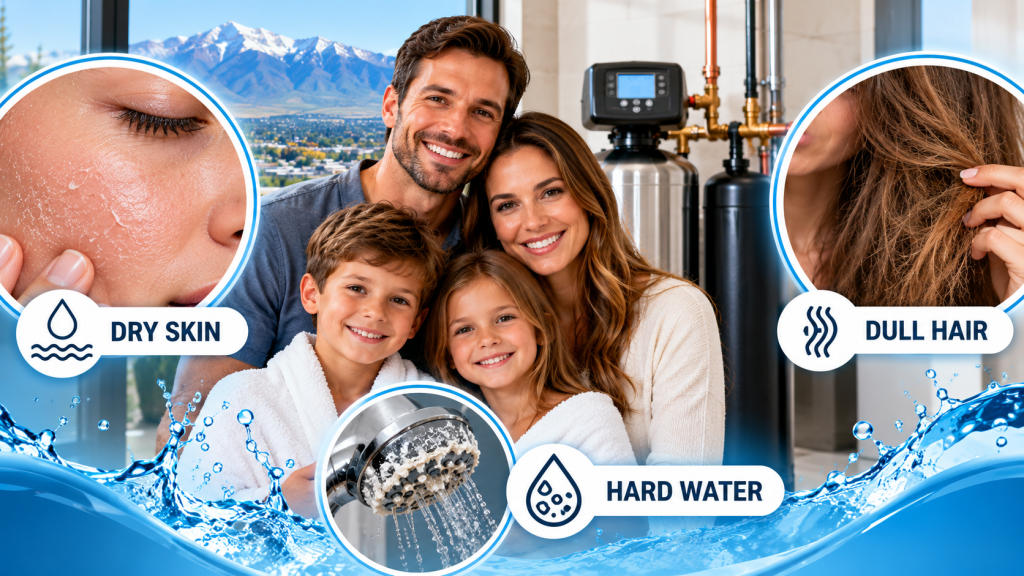
If your skin feels tight after every shower and your hair seems flat no matter what shampoo you try, the problem may be your water. Many Utah families never connect very hard water to their dryness and dull hair. Here is how hard water skin and hair problems start, why they are so common from Lehi to Herriman, and what your household can do.
Hard water contains high levels of dissolved calcium and magnesium. Utah has some of the hardest water in the U.S., and many Wasatch Front homes see water well above 7 grains per gallon, with 10 to 20+ common in many areas.
Those minerals are not a health hazard to drink, but they react with soap, shampoo, and your skin’s natural oils. Check your provider’s annual Consumer Confidence Report, or schedule a test at your home, since hardness varies by neighborhood.
When soap meets calcium and magnesium, it forms a sticky residue called soap scum that clings to skin and interferes with its natural oils. Many people notice:
Utah’s low humidity adds to the challenge. Some people with eczema report worse symptoms with hard water, but water treatment is not a medical treatment, so anyone with a persistent skin condition should talk with a dermatologist or doctor.
Hair is porous, and minerals build up on each strand. Common complaints include:
A few steps can help right away: use gentle, moisturizing cleansers, apply lotion while skin is still damp, try a clarifying shampoo occasionally, finish with a cooler rinse, and keep showers shorter. These treat the symptoms, but the minerals still come out of every tap.
Many shower head filters are designed to reduce chlorine rather than hardness, so check what a filter removes before buying one.
A water softener removes hardness minerals from all the water entering your home through ion exchange. Soap lathers more easily and rinses cleaner, and many families say their skin feels smoother and their hair more manageable. It also cuts scale on shower glass, faucets, and appliances. Some homeowners choose a water conditioner instead.
The right system depends on your water hardness, household size, and budget. Ask how hard your water is, what size fits your household, how much salt and water it uses to regenerate, and what maintenance it needs. A good provider answers clearly, not rushing you into the most expensive model.
Does hard water cause dry skin?
It does not directly cause a medical condition, but its minerals react with soap to form a residue that can leave skin dry, tight, or itchy.
Can hard water make hair fall out?
It is not generally considered a cause of hair loss, but buildup can make hair brittle and prone to breakage. If you are concerned about hair loss, talk with a doctor.
Will a water softener help both my skin and my hair?
For many families, yes. Soap and shampoo rinse more completely, leaving less residue. Results vary from person to person.
Tired of itchy skin and dull hair? Expert Water Systems has helped Utah homeowners for more than 24 years, installing and servicing roughly 400 systems every year. We carry more than 20 softener models, from budget-friendly to premium high-efficiency, and most installs are completed in a single day, often at about half the price of the big national companies.
Call (801) 836-4112 for free advice, or visit us at 1236 W 800 S in Lehi. We serve families across Utah County, Salt Lake County, Davis County, Park City, Heber City, and beyond.