
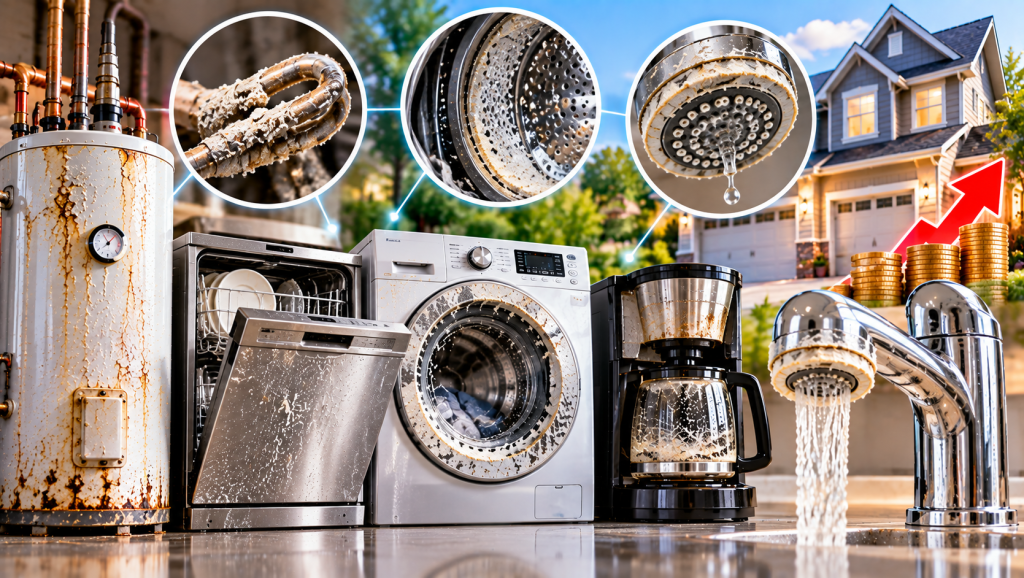
Most Utah homeowners notice hard water in small ways first: cloudy glasses, a crusty ring around the faucet, or a shower door that never looks clean. What is harder to see is the steady cost of hard water building up inside the appliances and plumbing you paid good money for. Over years, those minerals add up to shorter appliance lifespans, higher energy use, and more money spent on soap and cleaning products than you might realize.
Utah has some of the hardest water in the United States. Water moving through the mountains and valleys picks up calcium and magnesium, and readings of 10 to 20 or more grains per gallon are common in Utah County, Salt Lake County, and Davis County. Hardness varies by neighborhood, so a home in Lehi may test differently than one in South Jordan. Your provider’s annual Consumer Confidence Report gives a general picture, but an in-home water test tells you exactly what is coming out of your tap.
The dishwasher. Hot, high-pressure spray is exactly where minerals drop out and stick. You may see white film on glasses, scaled spray arms, a chalky heating element, and detergent that works less effectively. Rinse aids, boosters, and extra cycles become a recurring expense, and scale can mean earlier repairs.
The washing machine. Minerals react with detergent, so less of it cleans your clothes. Laundry feels stiff, whites turn dingy, and colors fade faster. Most people compensate with extra detergent and fabric softener, while buildup in hoses and valves may shorten the machine’s life and linens wear out sooner.
Faucets and shower heads. White crust, cloudy glass, and sputtering shower heads cost you in descalers, weekly scrubbing, clogged aerators and cartridges, and finishes dulled by harsh chemicals.
The water heater and pipes: the biggest hidden cost. When water is heated, calcium and magnesium settle in the tank as sediment and scale. That layer insulates the burner or element from the water, so the heater runs longer and uses more energy for the same hot water. Tankless heaters are affected too, with scale in the heat exchanger reducing performance and adding maintenance. In your plumbing, scale slowly narrows pipes and can reduce water pressure over the years.
No single problem looks like a big bill. The cost of hard water shows up as small, repeated expenses: extra detergent, specialty cleaners, higher energy use, earlier appliance replacement, new fixture parts, linens that wear out sooner, and time spent scrubbing. Seen that way, a properly sized water softener looks less like a luxury and more like protection for your home. The right system depends on your hardness, household size, and budget, which is why we recommend starting with a water test.
How do I know how hard my water is?
Your provider’s report gives a general range, but hardness varies across a city. An in-home test gives an exact reading for sizing a softener.
Will a water softener remove scale already in my appliances?
Softened water reduces new buildup, and some existing scale may loosen. Heavily scaled items, like an older water heater, may still need flushing or service.
Is a softener worth it if I only notice a few spots?
Visible spots usually signal more buildup inside your water heater, dishwasher, and pipes. If your water tests hard, as is common in Utah, a softener helps protect your appliances.
Expert Water Systems has spent more than 24 years helping Utah families choose the right water treatment, installing and servicing roughly 400 systems a year and carrying more than 20 softener models. Our pricing is typically about half of what big national companies charge, and most installations are finished in a single day. Call Expert Water Systems at (801) 836-4112 for free, no-pressure advice.