
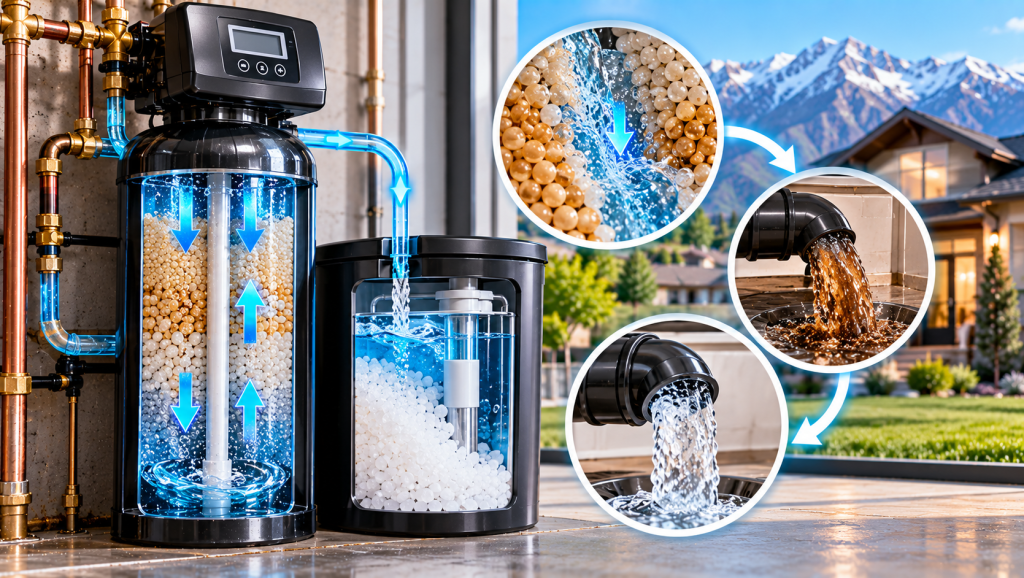
Your water softener does one of its most important jobs while you sleep: it cleans and recharges itself in a process called regeneration. When it is set up well, you get soft water without thinking about it. When it is not, your system may burn through bags of salt and send hundreds of gallons of water down the drain every month. Here is a plain-language look at how water softener regeneration works and how to tell whether your system is running efficiently.
Most home softeners use ion exchange. Charged resin beads grab calcium and magnesium from hard water and release sodium (or potassium) in their place. Once the beads are full, water passes through unsoftened.
Water softener regeneration flushes the minerals off the resin and recharges it, usually in the middle of the night:
The process takes an hour or two and uses salt and water, so how often it runs matters.
Timer-based softeners regenerate on a fixed schedule, such as every three or four nights, no matter how much water you used. If your family travels, the softener still uses salt and water.
Demand-initiated (metered) softeners track water use and regenerate only when the resin nears its limit. For most households, this uses less salt and water over time, and many high-efficiency models use precise brine settings to get more from every pound of salt.
Many Wasatch Front homes see 10 to 20 or more grains per gallon, so softeners from Lehi to West Jordan work hard. Watch for refilling salt more often than expected, nightly regeneration with low water use, cycling during the day, a rising water bill, or hard water spots even though salt is disappearing.
Common causes include a hardness setting higher than your actual water, a system sized wrong for your household, an outdated timer control, worn seals or injectors, and salt bridges that keep brine from forming. Our earlier article, “Clear Signs Your Water Softener Needs Repair,” covers related warning signs.
To get the most from every cycle, test your water, check the brine tank monthly for salt bridges, use clean quality salt, reset the clock after a power outage, and have settings checked if your household changes. An older timer-based unit may be worth upgrading.
How often should my water softener regenerate?
It depends on hardness, water use, and system size. Every few days is typical for many families on a demand-initiated unit; daily regeneration in a small household may mean the settings need adjustment.
Can I regenerate my softener manually?
Most control valves have a manual option, useful after refilling an empty brine tank or heavy water use. Check your owner’s manual.
Does regeneration use a lot of water?
Each cycle uses a set amount. Timer-based units often use more water overall than demand-initiated models.
Expert Water Systems has more than 24 years in water treatment and installs or services roughly 400 systems a year. We will test your water, check your settings, and explain what we find, whether you need an adjustment, a repair, or a more efficient system. We carry more than 20 softener models, our pricing is typically about half of what big national companies charge, and most installs take one day. Call (801) 836-4112 for free advice.